
I have always been an advocate of local journalism and signal boosting journalists and outlets that are doing good work. This is especially the case for outlets reporting on my community, because I am a Granite Stater that wants to spread accurate, important reporting to my audience and neighbors. An informed electorate ensures the government is kept in check, our free market dollars are spent strategically, and they know the who/what/when/where of their little world.
My community’s local newspaper, the Concord Monitor, is an avatar for soft journalism on important local issues, stemming from an inexperienced newsroom and lack of leadership.
“If a nation expects to be ignorant and free, in a state of civilization, it expects
what never was and never will be.” - Thomas Jefferson
The Concord Monitor is owned by Newspapers of New England, a conglomerate that includes three New Hampshire and three Massachusetts papers. To be fair, they are still family-owned and operated, something rare for larger outlets of any medium. Anecdotally, their advertising and marketing branch, NNEdigital, is what gets all the attention and it feels like their sales crew are in the field more than the reporters that should be the backbone of the operation. In their defense, the collapse of traditional funding models, like obituaries, classifieds, and print ads, have left this industry desperate to keep their doors open. What definitely doesn’t help is their confusing, long-term real estate planning where the handful of staff continued to operate out of an enormous, mostly empty building for years after the printing press moved across town.
There are a couple good reporters over there, namely veteran reporter David Brooks. Though he is a confusing fellow, shifting between traditional reporting and his lefty Granite Geek columns, but I have respect for his work. Photo editor Geoff Forester is also a cornerstone of the area. Unfortunately for the Monitor, they have shed countless reporters over the last decade, like Annmarie Timmins and Ethan Dewitt, who became founding journalists at the New Hampshire Bulletin five years ago.
Likely Source of the Issue
Senior reporters and editors are essentially nonexistent at the Monitor. They are almost entirely staff by inexperienced twenty-somethings that take the reins of the newsroom. Below is a listing of their reporters and how long it has been since they received their undergraduate degree, this is based on their website staff listing and their LinkedIn profiles:
News Editor Rebeca Pereira, three years
Community Editor Rachel Wachman, two years
Engagement Editor Emilia Wisniewski, one year
Reporter Sruthi Gopalakrishnan, who appears to be an Indian immigrant with four years in journalism
Statehouse Reporter Charlotte Matherly, three years
Reporter Jeremy Margolis, seven years (comparatively, very senior)
Reporter Catherine McLaughlin, five years
Reporter Alex Rapp, two years
How much this tremendously inexperienced staff is due to Publisher Steve Leone and Editor in Chief Jonathan Van Fleet’s leadership, the state of the employment market, or the lack of funding available to hire more senior reporters is not something I have intel regarding. A peak at the advertising team is revealing, with seven individuals that are mostly mid to late career. Seniority and pay is likely dedicated to the cash collectors and not the content, a disappointing state of affairs for local journalism.
Human Interest versus Data
Having such a young group of reporters with little senior staff to mentor or a clear investigative journalism focus has led to the Concord Monitor focusing a tremendous amount of time on human interest stories. Don’t get me wrong, the human element is a vital piece of storytelling and understanding the impact the world has on us as a society. But it must be a component and not the entire story. If I had a nickel for every time the Monitor staff were covering Democrat protests on the state house lawn, I’d be able to single handedly fund Alexandra Ocasio-Cortez’s likely presidential campaign. If I had a penny for every “Hometown Hero” article I could have bought a house for the late homeless “mayor” of Concord, the violent man romanticized by the Monitor, while glossing over his sex assault registration and history of arrest.
None of this involves “investigative journalism,” something claimed constantly by outlets as something they “can’t afford.” A mere 30 second Google search or a quick email to the city solicitor (the city’s attorney) is all that is required. Government self reporting and simple right-to-know requests are built into municipal and state law. Do these young reporters understand this? Do their bosses care? Who knows, but my basic research revealed bigger stories that I believe should have been their focus.
The following two examples were the straw that broke the camel’s back.
Hoopla
Modern, public libraries utilize many online services to either supplement their collection or make resources more accessible in our digital age. Services like Overdrive, Libby, LexisNexis, newspaper databases, and countless services accomplish this and are vital to maintain relevance to this important public service. But when budgets are getting cut due to wage and benefit woes for municipalities, services like these are the first thing that get the microscope. Rightfully so, in this example.
Hoopla touts they are, “your public library at your fingertips.” Also, that they, “more content, in more places, than any other digital library platform and it's all FREE thanks to your public library.” Their careful language around cost is vital to note, as you don’t find the word “free” anywhere on their library page. Their model is based on charging for each time Concord library user “checks out” a book from their digital library. In theory, that is fine for creators, but not necessarily for city budgets.
When the Concord Monitor covered Hoopla being removed from their services as part of a $38,000 budget cut for fiscal year 2027, it was met widely with residents being upset on Facebook. I clicked to view the article hoping to see how much of an impact that service being cut would have financially, but was met with nothing but comments from the Library Director Todd Fabian about it being a difficult service to manage and being expensive. The closest thing to data was the fact there were 19,700 total checkouts in 2025. Which is substantial and goes to show it is popular. But, how much of the $38,000 budget cut is this service going to represent?
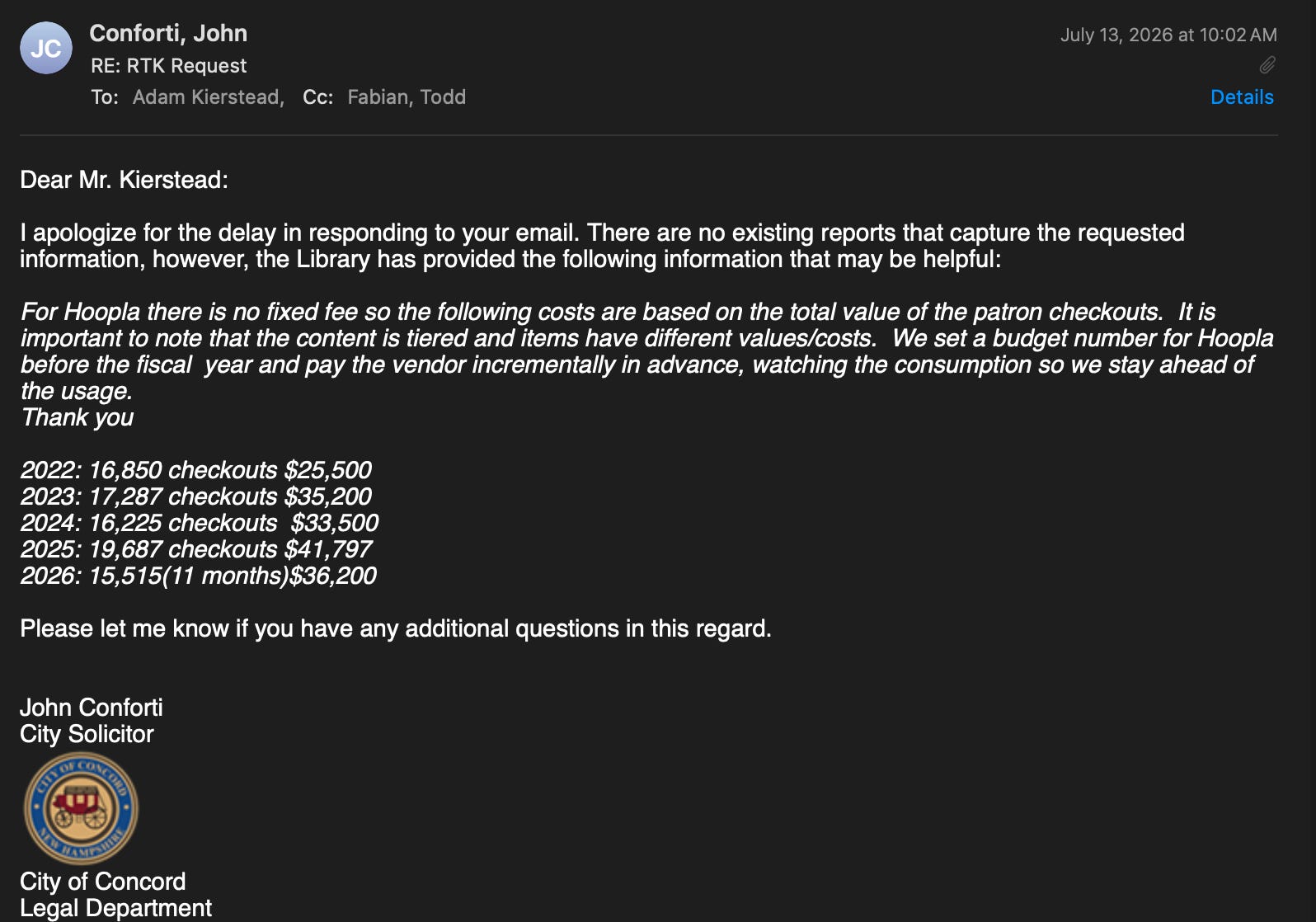
Well, apparently all of it… I reached out to the library director with a right-to-know request. After no response for a week, I reached out to the city solicitor and he responded within 24 hours. The numbers are substantial with Hoopla accounting for $22,500 to cover 16,850 checkouts in 2022 and rocketing to $36,200 to cover 15,515 checkouts in 2025. Their tiered products and per checkout model is extremely lucrative for the service, but terrible from a government transparency perspective. For example, using made up numbers, if you knew renting a movie was going to cost the city $5 each time for your kid to kind of watch on your phone while on a car ride, might you consider the broader impact? Maybe not, but enough people likely would when city budget time comes around. I did the math and it averages out to more than $2 per checkout, which is a considerable amount of money when there are analog, free, or advertisement based services that accomplish the same thing. Below is the email I received from the city solicitor.
As if this wasn’t enough of a failure on the part of our local reporters, my research led me to getting bombarded with advertisements from Labaton Keller Sucharow LLP, a law firm out of Florida. They setup portal for Hoopla users to submit claims against the service for,
Hoopla Digital, Inc. (“Hoopla”) is a digital media platform that allows library members to access eBooks, audiobooks, movies, and other digital material online and through its mobile app. Labaton is investigating potential claims against Hoopla on behalf of consumers who used the platform and whose reading or content viewing activity, together with their personally identifying information, may have been disclosed to third-party tracking or analytics providers without proper consent.
So not only is this service charging a tremendous amount of money for utilizing their library, they are possibly also selling this data on the backend to third parties. If you think this is just a scam on the part of Labaton, it is literally allowed Hoopla’s Terms of Service. Because Hoopla is a rental model, it operates much in the same way as Apple Movies and other services that offer “pay per use,” instead of strictly library access, like Spotify. They will work with third parties to hone advertising campaigns using your personal data.
Where is the reporting on this in the Monitor? Where is the breakdown of why Hoopla has such a large financial impact on our library?
The Cost of a Firefighter
The next example will not make me any friends, but it should have been reported comprehensively because of the fiscal and safety impact it has on the City of Concord.
In the Concord Monitor’s article, ‘‘Not going to stop:’ Concord firefighters press city to reopen pay raise negotiations,” I was hoping to finally figure out what all the hoopla was about with firefighter wages. There had been weeks of people posting about it online and hearing about the department being upset, but little context other than the city refusing to sit down with the union. Firefighters are an essential part of any municipality and ensuring they are paid appropriately, even in the midst of tightening budgets is vital.
But in the 684 words there is no mention of any financial data surrounding our fire department. There are references to two other exceedingly expensive projects that are important to note peripherally, “$41 million construction of a new police station and the $6 million renovation of the Beaver Meadow clubhouse.” While vital, it does not show how it impacts firefighter pay on an annual basis. There is extensive mention about how it is not competitive with other municipalities.
Since this dilemma is around firefighter wages and how they are allegedly not competitive to other municipalities in the state, I did what the Monitor was too lazy to do… I Googled “Concord, New Hampshire employee salaries.” And wouldn’t you know it’s the first thing that shows up in the results:
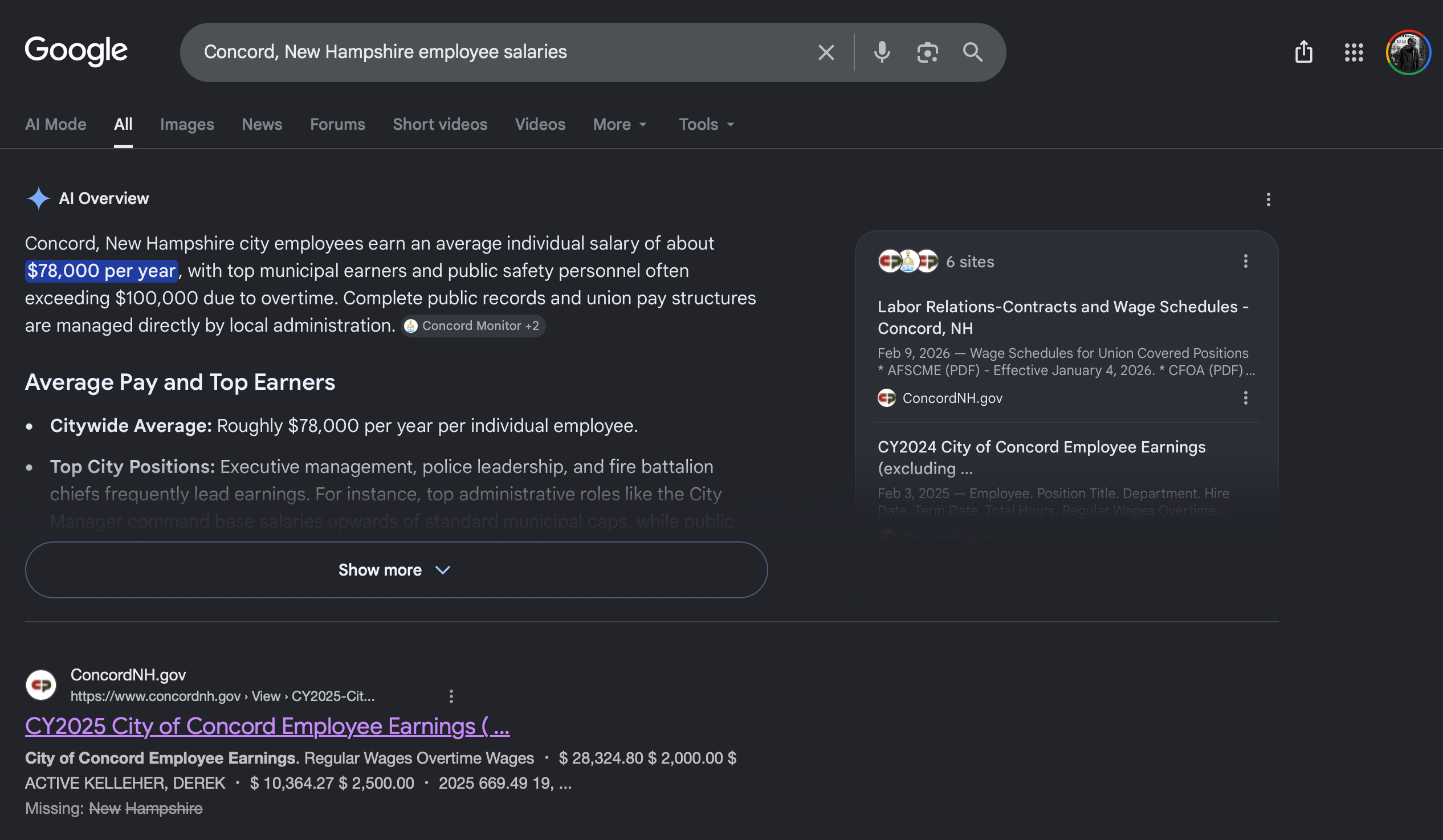
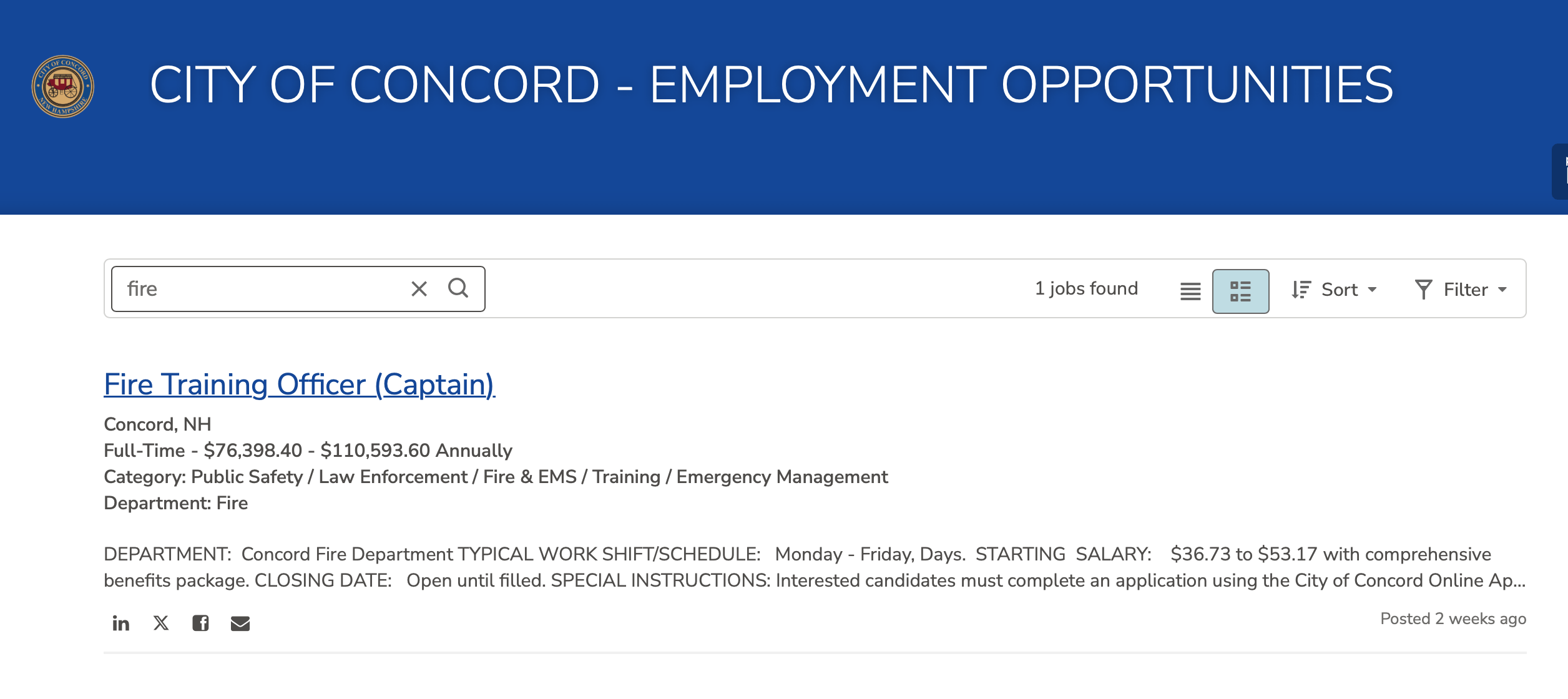
The spreadsheet of salaries is extensive, but easily parsed by searching text for “fire.” Maybe the Monitor staff didn’t want to come across as unfair by pointing out a majority of Concord firefighters make six figures between base salary and overtime, but I know that is important data to know they are making well north of the median salary of the city. In fact, on the city’s employment site, you can find current listing for a fire training captain that starts around the city’s media salary and goes up to $115k/year:
This is obviously a complex situation, balancing salaries, staffing, and overtime is a tale as old as unions. Personally, if the firefighters want to continue to have overtime, then raising their base pay is problematic at these current gross pay levels. If that equation doesn’t work for them, then the city should likely negotiate. But, this is essentially irrelevant because I have only one side of the story and the I only have some hard data was because I realized the Monitor failed me.
In conclusion…
It is ok to read the Concord Monitor, as long as you understand it does not offer more than a surface level look at the Capitol Region. Personally, I don’t rely on them at all. If only there was a magic wand to fix this complex situation that involves a lack of leadership, inexperienced writers, a medium that is flailing in the digital landscape, and, probably most importantly, a lack of funding to fix it. It would appear their double down strategy of NNEdigital and selling property is not filling the financial hole they are suffering. Newsrooms must become lean and mean, but it is apparent that the Concord Monitor’s attempt to face the new media landscape is a failure, propped up strictly by legacy.
A. J. Kierstead is a resident of Concord, New Hampshire and the Editor & Host of the New England Take. This article may be republished at no charge by emailing aj@newenglandtake.com.
Thank you to Tony Schinella of the Concord Patch for his feedback on this and confirming some of my suspicions on what is going on at the Monitor. Here’s some additional reading from his old site, Our Concord: